Have we met?
Hi! Emilse here (though most people call me Emi). That's me in the photo.
This is where I'm supposed to tell you I come from generations of musicians, that I was a child prodigy at seven, and that I play a prehistoric instrument worth 150 billion.
Can't do it.
Not my story. And it wouldn't help you anyway.
Let me tell you something else.
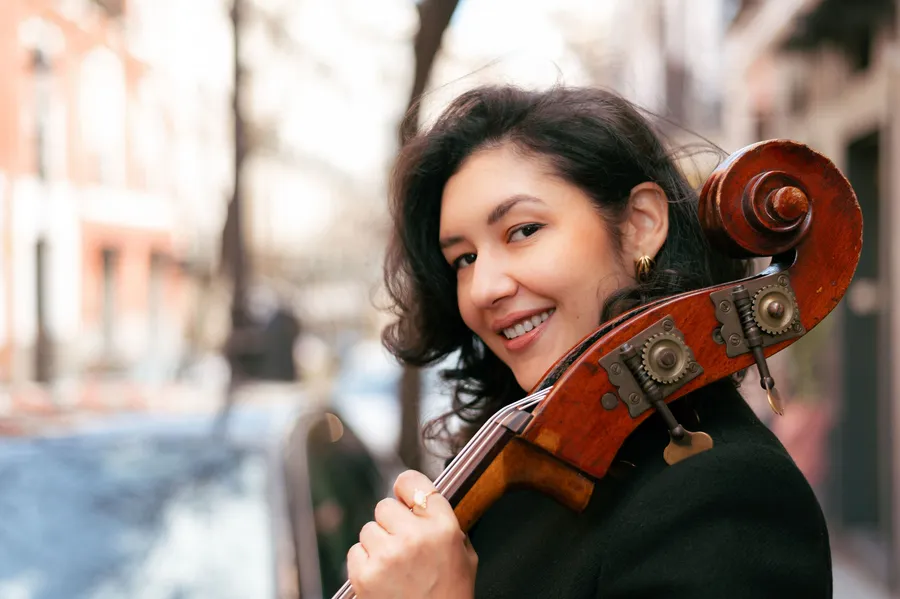
On my first day with the instrument, the conservatory teacher listened to me and said the double bass wasn't for me. That my hand was too small. That I didn't have the strength. That I was past «the right age».
I was ten years older than my classmates and I was at university studying Sociology. Starting an instrument as an adult is like that: in the academic world you're always behind. But you do bring something extra.
I like to call it conscious practice.
You know?
Like those people at the gym with their phone in one hand, chatting while they do the exercises. They're not really doing anything, they're wasting their time, training without paying attention. Same thing happens with the double bass.
And this whole being aware and paying attention to the details thing worked for me. I actually turned into an obsessive spy: asking, digging around, studying.
I found incredible teachers — the kind who don't lock you inside a book and make you grind through methods «until you get it right». Good teachers never do that. One of them was Félix Petit. By the way, I owe him every orchestra audition I've ever won.
Somewhere along the way I think I developed a superpower: I can spot the tiny detail that's holding someone back when they play.
It's not talent. Nobody teaches you that in school. It's what happens when you watch a lot, in a lot of different ways, without getting locked into one school of technique.
On that same road I found El Sistema, Venezuela's orchestra program, and that's when I understood why those first years had been so absurd. Because in El Sistema you're playing in an orchestra from day one. Even if it's on open strings, even if it's in one position. Your age doesn't matter. Where you come from doesn't matter. Their motto says it all: «Tocar y Luchar» — Play and Fight.
To my sociologist brain it made instant sense: music isn't a club for the talented, you don't have to be a seven-year-old with a special gift, and above all, you don't have to be ready before you start playing.
In those 10 years inside El Sistema I learned 3 things I want to pass on to you:
You learn by playing.
Anyone can do this.
Consistency without the right approach gets you nowhere.
How do I know?
Because seven years after that first «no», I became the first woman bassist to play as a soloist and in the section of the Maracaibo Symphony, in my hometown. And I ended up teaching at the conservatory that turned me down in the first place. Life has a way of coming back around.
For five years running I was invited on international tours with the Simón Bolívar Symphony Orchestra, under Gustavo Dudamel and conductors like Claudio Abbado.
And I was teaching the whole time: the Latin American Double Bass Academy, the Simón Bolívar Conservatory, the National Experimental University of the Arts, plus ten years training children's and youth orchestras in El Sistema.
Later, in Argentina, the Universidad Católica Argentina and the Orchestras for Equity Program.
And now?
In 2025 I took another leap into the unknown — that's what it felt like in my body, anyway.
I resigned from the permanent positions I'd won by audition in Argentina — assistant principal at the Avellaneda Municipal Symphony and bassist with the Buenos Aires City Symphonic Band — to travel, play, and see the world (a bit more of it).
Still doing that today. I'm based in Madrid, with an online academy where I train bass players all over the world.
If someone ever told you it was wrong without telling you how to fix it, I think you and I are going to get along. I write every week and tell you those details.
At the academy I also open 1:1 lessons in seasons, courses, and a membership. But I don't open them to the general public — I share them with my community only. This is the way in.
Double Bass in the City