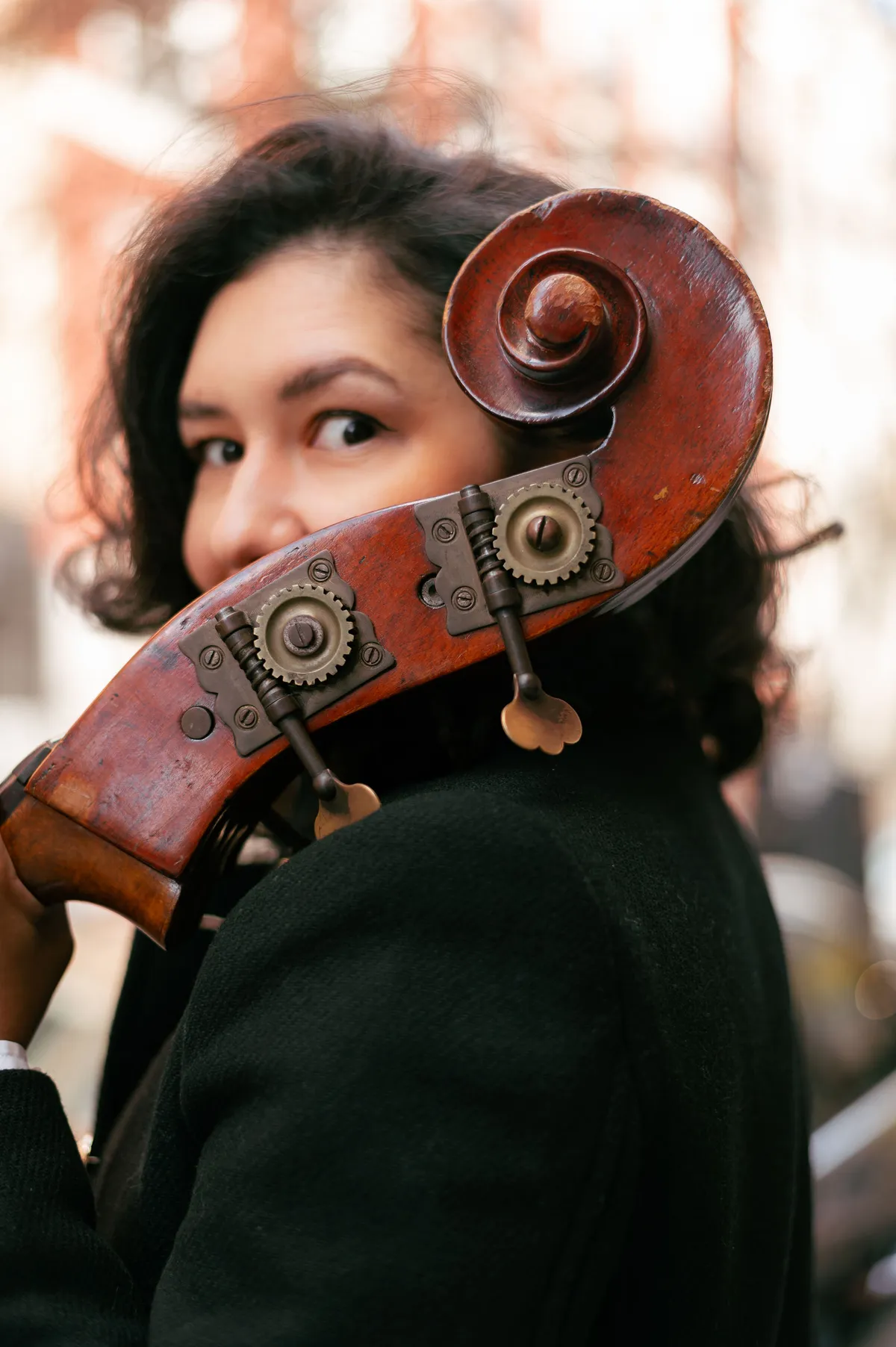
Seven volumes of a method won’t prepare you to solve problems on stage.
Let me tell you why.
You show up to rehearsal. They handed out the piece two weeks ago and there’s a passage you can’t get. You practiced it. Practiced it a lot, actually.
But you can’t crack it. And the people next to you can: they’ve got more experience, and they’ll tell you things like “use more bow going into thumb position and the string won’t choke,” “the trick for making that fast passage speak is to think of the string as having two different sides,” “if you anticipate the shift the passage sounds more connected.”
It took them about 20 years to figure those details out. They can hand them to you in a second.
That’s why I brought this membership into the world — to be your stand partner. And those details, I explain them in 4-minute videos, or 5 depending on what we’re working on.
Let’s Study Together is an exercise membership. 90% of what we work on is the bow.
Why?
Because it’s what methods teach you least.
Because it doesn’t matter whether you’re practicing on your own or sitting in a conservatory, what I run into is always the same: progressive methods built around the left hand.
By the way, here’s a comment from a subscriber. I copied it as-is (translated from Spanish):
«Before this membership, I only ever saw one method, scales, everything focused on the left hand, and honestly I wanted to improve that because I think my bow is a weak spot. It helped me become more aware of how I produce sound. I used to play with a lot of pressure and that got me injured; now I understand much better how everything works. I use it as my warm-up every day, and then I get on with whatever I have to practice for the conservatory.»
Enough with the bow being an afterthought.
Between 2012 and 2014 I took master classes with Klaus Stoll, former solo bassist of the Berlin Philharmonic.
One thing he said stuck with me. He said it while I was playing the Dittersdorf, obsessed with finding the perfect fingering. All wrong, ha!
“The bow is our mouth, our teeth and our tongue.”
It’s our single greatest tool for communicating.
I was looking for the answer in my left hand. It was in my right.
And it makes no difference whether your goal is orchestra, whether you play jazz, pop music, or you just enjoy playing all the Bach suites in your living room.
Everyone plays the notes — if they practice, obviously, ha — but how they play them, what kind of sound they get, how they shape the passage: that’s 100% the bow’s work.
Have you noticed? You practice the notes over and over, you drill them, and then when you play there are whistles, vibrations you can’t explain, the sound is nasal, it’s flat, there’s nothing expressive about it.
You can’t figure out how to make it sound like the recording you’ve listened to 650 times. The notes are there — the problem is you’ve set aside your main tool for communicating.
The bow.
That’s why Let’s Study Together exists.
Every Thursday I leave you one exercise on the platform. One. Built on a technical concept I explain once a month: where the movements come from, the coordination, the sound. Where things come from, not how to repeat them.
Here’s what Mario wrote me — a former student from the jazz world who’s now in the membership:
«The platform is really intuitive and I love the exercises. I don’t always have time to watch them, but at least I stay active. The bow work is really, really good.»
So, every Thursday, when the new exercise goes up, the old one disappears.
Yes, you read that right. I delete the previous content.
Why would I do that?
Because libraries overwhelm you. Fifty exercises filed away “for later” end with you doing none of them — and carrying the guilt of doing nothing on top of it.
If what you want is an infinite library of exercises you’ll never do or fully understand, you can go to YouTube. It’s free, and you can keep yourself busy all day, spending hours just hunting for the exercises that are right for you. Good luck with that.
Here there’s one exercise this week. Do it and you move forward. Don’t do it and it’s gone, and another one comes. No guilt. Simple.
Think one exercise a week isn’t enough? Here’s what Laura wrote me:
«Yes, I feel it helped me organize my practice a bit more. Since they’re small tasks, I can do them even when I’m short on time and still work toward a goal.»
And guess what? You get a direct line to write to me. I answer, not an AI. This is a membership with real support behind it.
And this one came from a dad:
«I got it for my son so he could work on technique on his own. He told me it’s very easy to understand, that he understood why you shouldn’t squeeze with your thumb, and he likes the exercises.»
I genuinely believe German bow is the most natural way to hold a bow, and because of that the bow strokes come far faster. That’s why this membership is built around German bow.
The people who’ve gotten the most out of this membership:
- Conservatory students buried in method books (the standard conservatory program), where the bow plays second fiddle.
- Jazz players who want to bring the bow into their playing, take bow solos, and offer something nobody else in the room is doing.
- Popular musicians who want to learn bow so they can add solos and melodic lines to their repertoire.
- Bass players who feel stuck with French bow and want to switch to German and get comfortable with it fast.
- People practicing on their own who want one clear weekly goal to keep moving technically.
This membership is NOT for you if:
- You’re after an infinite library of exercises to save and watch someday. There’s no library here, no archive, no “I’ll get to it later.”
- You need to prepare something specific: a conservatory entrance, an audition. That calls for private lessons. This keeps you technically in shape and builds your foundation; it won’t solve a particular piece of repertoire.
- You don’t have a couple of hours a week. It doesn’t have to be every day, but it does have to be a couple of days each week. The exercises aren’t magic — they are very good, but you have to put the time in.
One last one, from Paloma, before I tell you what’s included:
«When I joined, I found a bonus video that’s really good — things I maybe already knew but you forget to put into practice. I also like that the exercises are short. I watch them when I have time, and I feel they get my technique going.»
What’s included
Let's study together
Price
€65/mo
€65 a month. That price locks in for you: whenever you join, that’s what you pay for as long as you stay.
- Every Thursday, a new exercise on the platform built on a core concept.
- Every month, one technical concept is explained — the core concept. Just one. Simple.
- Access to the platform 24/7, wherever you are.
- A direct chat for your questions. I answer them personally.
Doors close on September 2 at 23:59 CESTThe doors are closed. They open on October 1. Tell me when they open
You’re billed monthly on the day you joined: join on the 20th and your month runs the 20th to the 20th. You never lose days. You can cancel whenever you want, no explanations. One thing though: if you leave and come back later, you come back at whatever the price is then.
Let’s Study Together!
Doors close on September 2 at 23:59 CESTThe doors are closed. They open on October 1. Tell me when they open
Frequently asked questions
Does it work if I play French bow?
The concepts, yes: the sound, the distribution, where the movement comes from. But I wouldn’t recommend it — this is built for German bow. I wouldn’t recommend French bow either, but that’s my unsolicited opinion for the day.
Do I need to be advanced?
No, but you do need at least the first positions and some ease holding the bow. I adapt every exercise for beginner-intermediate and advanced.
What if I join mid-month?
You get that week’s exercise until the next Thursday replaces it. The concept of the month stays up all month.
How much time do I need?
A couple of days a week, half an hour each. No more than that.
How does payment work?
Automatic monthly subscription, like Netflix. You’re charged on the day you join and that’s your billing day every month.
Can I cancel anytime?
Yes, from your account, without explaining anything. You keep access until the end of the period you’ve paid for. If you come back later, you come back at whatever the price is then.
How do I ask my questions?
There’s a message box inside the classroom. You write, I answer.
What language is it in?
English and Spanish. Sign up in whichever you prefer.
Is it less than a lesson?
Yes. One private lesson costs more than a full month of the membership (one concept explained properly and 4 exercises to work on it).
When can I log in?
24/7.
I have a question that isn’t here.
Write to me at info@emilserios.com and I’ll answer personally.
Doors close on September 2 at 23:59 CESTThe doors are closed. They open on October 1. Tell me when they open
Not subscribed to the newsletter yet?